
The government is finalising the national action plan on climate change and would release this in June, said Shyam Saran, Prime Minister's special envoy for climate change. The action plan would focus on key issues like improving energy efficiency, harnessing solar energy, studying the melting and cracking of icebergs on the Himalayas and understanding the dynamics of coastal and island territories.The plan would contain mechanisms for implementation of various policies.

Minister of State for Environment and Forests Jairam Ramesh said India will forward its domestic goals on climate change as its action plan under the Copenhagen Accord to the Conference of Parties (COP) of the UN Framework Convention on Climate Change (UNFCCC).

Javadekar was addressing the 18th BASIC ministerial meeting on climate change here which is being attended by ministers of Brazil, China and South Africa.
Necessary funds are proposed to be allocated for the eight national missions that are being launched following the National Action Plan on Climate Change (NAPCC) unveiled last year.
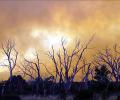
He said the coastal and deltaic regions of India are reported to be vulnerable to the risks of flooding.

India has rescued three more nationals, including a child, from Nepal's flood-hit Trishuli Bazaar, bringing the total evacuees to 169, while 275 Indians remain missing. The Ministry of External Affairs confirmed that 1,907 Indians safely crossed into Nepal from China and India continues to provide extensive relief materials and expert teams to assist Nepal in its recovery efforts following the devastating flash floods.
A report by the University of Chicago's Energy Policy Institute projects approximately 15,800 additional heat-related deaths in India over the next six months due to the 'super El Nino' phenomenon. Globally, nearly 451,000 additional deaths are anticipated. Experts in India emphasize the need for swift action, including implementing Heat Action Plans and focusing on vulnerable populations, while also urging caution regarding model-based projections.

India should encourage the second coming of SAARC with climate change as an urgent agenda and keeping Indian security concerns in mind as the subtext, suggest Lieutenant General Ashok Joshi (retd) and Colonel Anil Athale (retd).

Uttarakhand was a tragedy that none of us will forget. As experts analysed the tragedy, it became clear that the disaster was more man made. The intergovernmental panel on climate change in its Assessment Report 5 states that human influence on the climate system is clear and this is evident from the increasing greenhouse gas concentrations in the atmosphere, positive radiative forcing, observed warming, and understanding of the climate system.

In a statement, Energy Secretary Earnest Moniz said this is the most ambitious initiative any president in history has taken to reduce heat-trapping emissions.

Climate action plans of poorest nations to cost $1 trillion.
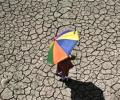
Unless we act dramatically and quickly, science tells us our climate and our way of life are literally in jeopardy, says Kerry.
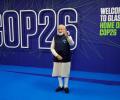
India lost around 38.5 thousand hectares of tropical forest in the last decade. Nearly 14 per cent of the country's tree cover! It is one thing for Modi to announce that India will reach a net-zero level of emissions in 2070. But if it is serious, it needs to start today, points out Ramesh Menon.
R K Pachauri, chief of the Intergovernmental Panel on Climate Change, said in the effort to structure a new climate change regime by 2009, there had been no major breakthroughs since the creation of the Bali action plan, but 'all eyes are focused on the G-8 summit' of industrialised countries. The Bali action plan was adopted as a two-year process to finalise a building agreement on Climate change at a UN conference in Indonesia last year December.

The Ministry of External Affairs reported that 275 Indians remain missing following devastating flash floods along the Nepal-Tibet border, while 166 others have been rescued. India has supplied 95 tonnes of relief material and deployed 54 personnel, including rescue and forensic experts, to assist Nepal. The death toll in Nepal has reached 1,295, with thousands still missing, and significant infrastructure damage reported. India has also highlighted the need for developed countries to lead in climate change action.
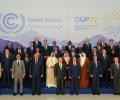
The overwhelming feeling at the end of COP 27 was that despite decades of meetings and landmark accords, like the Paris Agreement, the world was still not doing enough to slow the climate crisis, observes Ambassador T P Sreenivasan.

'Since there is no photo-op, or quick fix solutions, politicians do not want to address climate change. It is very unfashionable.'

Worse still, the cities ranked second, third and fourth for their poor air quality are also in India.
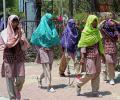
The global body added that national meteorological and hydrological departments in both countries are working closely with health and disaster management agencies to roll out heat health action plans.

During his three-day UK visit until Tuesday, Modi is listed to address the COP26 summit with a national statement about India's climate action plan in the afternoon session on Monday, ahead of Australian Prime Minister Scott Morrison and Pakistan Prime Minister Imran Khan.

'At COP30, the emphasis will be on unlocking climate finance, reinforcing the principle of common but differentiated responsibilities, and building resilience through inclusive transitions and the mainstreaming of adaptation.'

Currently, the NAPCC has eight active missions across sectors like water, energy, and agriculture, aimed at addressing climate change.

Environment Minister Prakash Javadekar said adaptation to the adverse effects of climate change is vital in order to respond to the impacts of climate change that are already happening, while at the same time preparing for the future.

States are mandated to develop and implement 'heat HAPs' for prevention of heat-induced diseases. But most do not go beyond standard advisory on heat prevention.
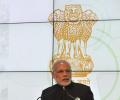
"Climate change is a major global challenge. But it is not of our making," Modi said.

The steps included conservation of Himalayan ecology,regeneration of forest and promotion of cleaner fuels to bring down carbon emission.
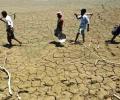
The UNEP Adaptation Gap Report highlights gaps worldwide in finance, technology, and knowledge.

'There needs to be a monitoring of glaciers in high altitude areas and one needs to check regularly how geological changes are taking place.' 'We can mitigate that by regular monitoring but unfortunately, hardly any monitoring is happening.' 'And without monitoring those higher altitudes of Himalayas, people are suffering.'

Across the world rallies were held to draw attention to climate change ahead of a United Nations summit in New York.

The devastating floods in Nepal have brought back memories of two major disasters in Uttarakhand in recent years, the Rishiganga tragedy of February 2021 and the Dharali disaster of August 2025, which caused extensive loss of life and property and left thousands struggling to rebuild their lives.
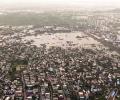
How the UN's flagship climate summit lost its direction and what's at stake.

The experts said that climate change is not only raising temperatures and making India's heatwaves hotter, but also changing weather patterns that further drive dangerous weather extremes.
The target is called Intended Nationally Determined Contributions.

Senior journalist Darryl D'Monte reports exclusively for Rediff.com from Paris.

This was perhaps a missed opportunity for India to spotlight a core domestic challenge: The scale of workforce preparation required for a young, populous, rapidly growing country seeking to reach net zero, points out Radha Roy Biswas.
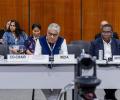
India will publish its revised Nationally Determined Contribution (NDC) for the 2035 period by December, Environment Minister Bhupender Yadav said on Monday, while urging developed nations to achieve net zero targets ahead of their current timelines.

Developed and developing countries are very different and they are different from variety of reasons on climate change.

About 57 per cent of Indian districts, home to 76 per cent of the country's population, are currently at high to very high risk from extreme heat.

Poland's Secretary of State, Wladyslaw T Bartoszewski, has credited Prime Minister Narendra Modi with preventing Russian President Vladimir Putin from using tactical nuclear weapons in Ukraine in late 2022, highlighting Modi's significant influence on the Russian leader.

White House said Trump strongly believed that protecting environment and 'promoting our economy are not mutually exclusive goals'.
